“Every person carries within him-or herself patterns of
thinking, feeling and potential acting that were learned throughout the
person’s lifetime. Much of it was acquired in early childhood, because at that
time a person is most susceptible to learning and assimilating. As soon as
certain patterns of thinking, feeling and acting have established themselves
within a person’s mind, he or she must unlearn theses patterns before being
able to learn something different and unlearning is more difficult than learning
for the first time”
(Hofstede et al.,2010,p.4).

Introduction
Employee
Engagement is a workplace approach which plays a vital role when considering the
Organizational Performance. According to Vance (2006), the employer will “go
the extra mile” and perform extremely well if his or her level of engagement towards
the work assigned is high. Jaupi and Llaci (2015) believed
there is a connection between employee engagement and business results. From
employer’s point of view, employee engagement is the where the employee fits energetically
and actively towards organizational goals and objectives. Further, Organization
is concerned that employee engagement focuses mainly on positive attitudes and
behaviours of employees where they feel the pride and being loyal for the
organization at the same time. From employee’s point of view, employee
engagement is a combination of Job Satisfaction, Psychological contract, Motivation
and Commitment. Employees are identified as assets of an organization and
according to Armstrong (2010); an organization can achieve competitive
advantage in those assets (employees) by employee engagement through strategic and
conscious investments. Organizations are where the theme employee engagement
dynamically put in to practice.
Employee
Engagement
According to Armstrong (2008),
engagement is the development and implementation of policies designed to
increase the level of employees’ with their work and the organization. A simple
way of defining this theory is keeping promises to employees by their
organization or giving reasonable and satisfactory explanations on the reasons
why the promises cannot be kept. Armstrong (2014) saw engagement as having
three core features:
1.
Intellectual Engagement - Thinking hard
about the job and how to do it better
2.
Affective Engagement -
Feeling positively about doing a good job
3.
Social Engagement -
Actively taking opportunities to discuss work-related
Improvements
with others at work
The term ‘engagement’ can be described
where the people or employees of a particular organization are positively
interactive, excited, motivated and discretionarily committed towards their job
or work Armstrong (2014).
The Components
of Employee Engagement
Figure 1

SOURCE: Armstrong (2014)
Positive Discretionary Behaviour and
Employee Engagement
According
to Armstrong (2010), there is well-established connection in between employee
engagement and discretionary behavior.
· When the employees of an organization
are highly motivated or experiencing higher levels of job satisfaction,
employee engagement occurs more.
· When the HR policies of an organization
concerned more on creation of a capable workforce, the employees take positive
aspects of those policies which results increased commitment, motivation and
job satisfaction either together or separately.
· If the number of HR policies required
developing ability, motivation and opportunity are in place and reinforced, the
positive approach may be more accepted.
· The way in which the top management has
implemented and the front-line managers have adopted the HR policies may
enhance or weaken the effect of the same.
· The more the positive outcomes
experienced the more the positive attitudes generated.
The Sears
Roebuck Model/ Engagement Model
Figure 2: The Sears Roebuck Model:
Employee-Customer-Profit Chain

SOURCE: Armstrong (2006)
Drivers of Employee Engagement
Armstrong
(2014) listed following as drivers of employee engagement:
· Job
Challenge - This
takes place when there is a job with broader scope, high
responsibility and high
risk appears.
· Autonomy - The freedom and
independence allowed for employees when
they schedule and
structure their work.
· Variety - Jobs with a variety that is
jobs performed with different sets of activities and skills.
· Feedback - Direct and clear information
will be provided on how effective the employees performed.
· Fit - The amount of compatibility
between the employee and his or her work environment which allows employees to
see what they want to see.
· Opportunities for development -
Employees’ committed work are appraised by providing pathways to climb up
towards their growth.
· Rewards
and recognition - Represents direct and indirect returns on personal
initiatives and investments of employees.
Characteristics of Employees based on
Engagement Level
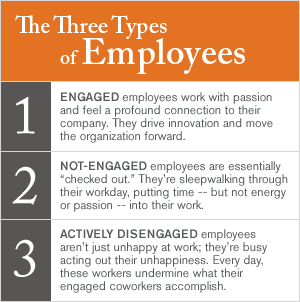
According
to Krueger and Killham (2006), the following are the engagement levels:
1. Engaged
Employees - Express great passion and very well connected to their work
2. Disengaged
Employees - Express no passion at all, just completing their day-to-day work
3. Actively
Disengaged Employees – Unhappy employees spreading unhappiness
Figure
3: The Three Types of Employees
(Source: Krueger and Killham, 2006)
Positive
Aspects of Employee Engagement
According to Jaupi and Lalci (2015),
well-established relationship exists between Employee engagement and
motivation. Muzee, Bagire and Ngoma (2016) stressed out that as more and more
employees are looking for pleasing working environments, their engagement level
and self expression will also result high. Kazimoto (2016) identified employee
engagement as the presence of workers at work place fulfilling their
commitments and responsibilities. Further, Kazimoto (2016) indicates the
measuring of employee engagement easily help organization understand the
requirements needed to uphold organization performance.
Obeidat (2016) identified a key impact
of employee engagement that is higher the employee engagement, higher the
appliance of corporate social responsibility which results a gain in both the
society and the organization. Obeidat (2016) further stressed out corporate
social responsibility on the other hand will work as a tool to maintain the
engagement of its current or existing employees. Dai and Qin (2016) signified there
is a positive impact of employee engagement on organization’s performance
considering long term developments. According to views of Bai and Liu (2018),
the employee career growth has a considerable and severe impact on
organizational commitment, employee engagement, turn-over intention and work
performance.
Bellini, Ramaci and Bonaiuto (2015)
insisted and claimed there is a core relationship between employee engagement
and organizational cynicism. Cynicism is the belief of people and their
motivations are purely by self-interest. Chandel (N D) confronted employee
engagement act as an indicator to show up the involvement and association of an
individual employee with an organization. The author insisted there is a lot to
consider when it comes to the way the employees feel about their own organization
and how well they are being treated by their own organization.
Aspects Where
Employee Engagement Will Not Simply Work
Though, Davis and Cates (2013) insisted
the major issues in which the employers have to deal with as workplace
isolation issues and the lack of employee engagement, Beetham and okhai (2017) argued
that the people with low engagement and low career well being are just waiting
for the end of the workday.
However, the negative aspects of
employee engagement are also researched and published by a number of
researchers. Zhang (2019) insisted on the employee pressure and resistance
caused by organizational change. That pressure and resistance will develop root
cause problem with engaged employees as well as not-engaged and actively
disengaged employees. According to Zhang (2019), there are three categories of
technical changes where the employee pressure and resistance will emerge.
1 The Replacement of Equipment
2 The Change of Working Mode and Working
Environment
3 The Improvement of employees’ knowledge
and skills
Though
the employees are actively engaged and highly motivated, these changes will
give both positive and negative impacts on their
performance irrelevant their level of engagement and motivation.
T
The Relevance of Employe Engagement to
the Service Industry in Sri Lanka
The organization which I worked for is a
leading commercial bank in Sri Lanka. The organization maintains a culture
where the employee and employer both will benefit the positive aspects of
employee engagement. According to the Annual Report of 2017, the bank serves
its customers with staff strength of 4,982 both in Sri Lanka and Bangladesh and
in Sri Lanka and Bangladesh bank are maintaining 280 and 19 branches
respectively.
Table
1:
Comparison between the Financial Years 2017 and 2016 with regard to the
Employees
|
|
2017
|
2016
|
|
Total Employees
|
4,982
|
4,987
|
|
New Employee Hires
|
4.88%
|
5.43%
|
|
Attrition Rate
|
4.86%
|
4.61%
|
|
Return to work after Maternity Leave
|
94.64%
|
95.38%
|
|
Skill Development Programmes
|
12,937 Hours
|
14,650 Hours
|
|
Percentage of Employees receiving Performance
Evaluations
|
100%
|
100%
|
(Source: Commercial Bank of Ceylon PLC Annual Report
2017)
Adherence to standards, policies, rules
and regulations requires the positive engagement, dedication and commitment of
the employees of the bank. The employees continuing discharge their duties and
prepare themselves with higher skills and qualities inspired by the bank with
their loyalty and active participation. Further, Bank is also putting up and
implements strategies to place the necessary systems and processes to support
the employees’ valuable work.
Recommendations and
Conclusion
On the one hand engaged employees will
result higher productivity, enhanced individual performance, high retention,
higher customer satisfaction and profitability, improved attention and reduced
levels of staff churn or attrition rates in the organizational performance of any
organization. On the other hand, actively disengaged and not-engaged employees
will result less productivity, higher staff churns rates, lower employee
retention, and poor attendance, less customer orientation and de-motivation and
frustration among colleagues in the organization. Though the theme employee
engagement is still emerging and relatively new to SHRM, Commercial Bank of
Ceylon PLC as a leading and award winning private bank in the industry is
successfully attracting highly engaged, self motivated and committed work force
through their best practices which involves the creation of better and healthy
working environment for the employees and the strong relationship building
between the employees, management and the top management. From the beginning
process that is from the recruitment process of the employees, throughout the
trainings and other skills development programme conduction and towards
retention of employees, an organization must focus on active employee
engagement and commitment while building up a healthy and supportive working
environment.
List
Of References
Armstrong, M. (2006) A
Handbook of HUMAN RESOURCE MANAGEMENT PRACTICE, 10, 41.
Armstrong, M. (2008)
STRATEGIC HUMEN RESORCE MANAGEMENT. A
GUIDE TO ACTION, 4, 59.
Armstrong, M. (2010)
The ARMSTRONG’S ESSENTIAL HUMAN RESORCE MANAGEMENT PRACTICE. A GUIDE TO PEOPLE MANAGEMENT, 1, 72-157.
Armstrong, M. (2014)
ARMSTRONG’S HANDBOOK OF HUMAN RESOURCE MANAGEMENT PRACTICE, 13, 194-196.
Bai, J. and Liu, J.
(2018) A Study on the Influence of Career Growth on Work Engagement among New
Generation Employees. Open Journal of
Business Management, 6, 300-317.
Beetham, J. and Okhai,
L. (2017) Workplace Dyslexia & Specific Learning Difficulties-Productivity,
Engagement and Well-Being. Open Journal
of Social Sciences, 5, 61.
Bellini, D., Ramaci, T.
and Bonaiuto, M. (2015) The Restorative Effect of the Environment on
Organizational Cynicism and Work Engagement. Journal of Human Resource and Sustainability Studies, 3, 124-135.
Chandel, P. (N D) EMPLOYEE ENGAGEMENT AND ITS EFFECT ON
ORGANIZATIONAL COMMITMENT AND JOB PERFORMANCE: A STUDY OF HIGHER EDUCATION INSTITUTIONS,
Ph. D. Thesis. Bahra University.
Commercial Bank of
Ceylon PLC (2017) Annual Report.
Dai, K. and Qin, X.
(2016) Perceived Organizational Support and Employee Engagement: Based on the
Research of Organizational Identification and Organizational Justice. Open Journal of Social Sciences, 4, 47.
Davis, R. and Cates, S.
(2013) The Dark Side of Working in a Virtual World: An Investigation of the
Relationship between Workplace Isolation and Engagement among Teleworkers. Journal of Human Resource and Sustainability
Studies, 1, 10.
Hofstede, G.,Hofstede
G.J and Minko, M. (2010) Cultures and Organizations
SOFTWARE OF THE MIND. 1st ed. McGraw-HILL.
Jaupi, F. and Llaci, S.
(2015) The Impact of Communication Satisfaction and Demographic Variables on
Employee Engagement. Journal of Service
Science and Management, 8, 191-200.
Kazimoto, P. (2016) Employee
Engagement and Organizational Performance of Retails Enterprises. American Journal of Industrial and Business
Management, 6, 516-517.
Krueger,
J. and Killham, E. (2006) Who's Driving Innovation at Your Company?. [Online]
Available
at: <http://news.gallup.com/businessjournal/24472/whos-driving-innovation-your-company.aspx/>.[Accessed on 14 May 2019].
Muzee, H., Bagire, V
and Ngoma, M. (2016) Strategic Leadership and Employee Engagement, Evidences
from an African Industrial Setting. Open
Access Library Journal, 3, 2.
Obeidat, B. Y. (2016)
Exploring the Relationship between Corporate Social Responsibility, Employee
Engagement, and Organizational Performance: The Case of Jordanian Mobile
Telecommunication Companies. 9, 363-364.
Vance, R. J. (2006)
Employee Engagement and Commitment a
guide to understanding, measuring and increasing engagement in your
organization, 1(1).pp.2[Online].Available at<www.shrm.org. >.[Accessed
on 14th May 2019].
Zhang, Y. (2019)
Research on Employee Pressure and Resistance Caused by Organizational Change-A
Case Study of Jingyi Network Co. Ltd.. Open
Journal of Social Sciences, 7, 74-77.
